
Kullait is a unique diabase found only on the Kullaberg Peninsula, one of southern Sweden's most prominent geological landmarks. Here the ancient bedrock rises majestically, forming a natural dividing line between the Kattegat to the north and the Øresund to the south.
In recent years I have photographed this landscape with analogue small-format cameras and then developed black-and-white prints in the darkroom. The resulting images — rich in grain and high contrast — capture the intricate textures of the cliffs and rocks. I have also explored the hidden world of the stones by photographing rock samples from the area through a microscope. This method reveals fascinating parallels in shapes and patterns that echo those in the visible world around us.
My intention with these images is to capture both the drama and the stillness of this place, and to reflect on its present essence as well as its timeless history.
Accompanying the book is a text on the geological history of Kullaberg by Mikael Calner, professor at the Department of Geology, Lund University.
The cover has a foldout section and is printed on silver-coloured board — reminiscent of the silver used in the analogue photographic process. The last text pages are printed on rust-coloured paper, referencing the colour of the diabase kullait.
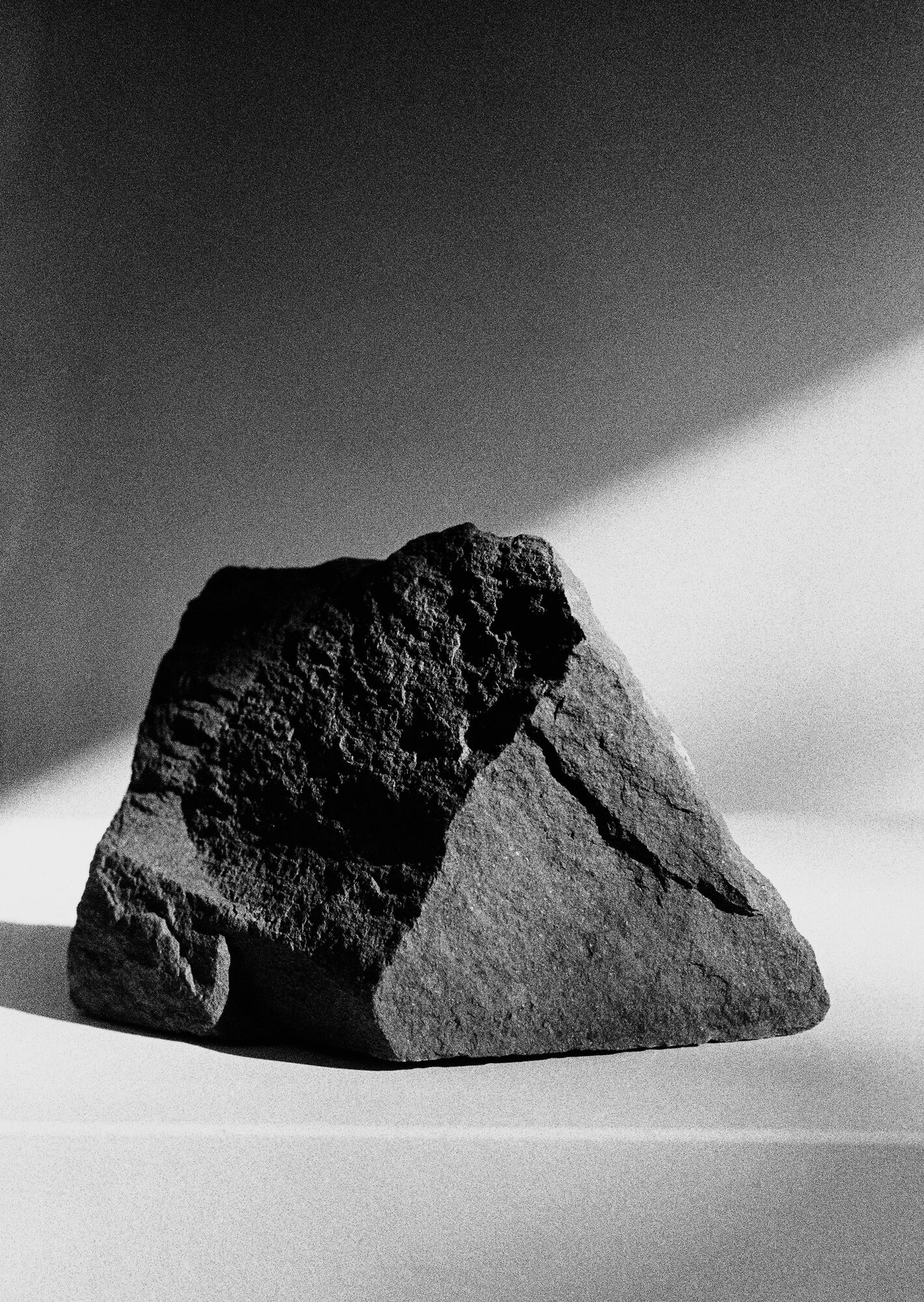
All black and white photographs in Kullait are made using analogue small-format cameras and printed by hand in the darkroom. Silver gelatin prints — rich in grain and tonal depth — are the medium that does justice to the ancient textures of Kullaberg. No digital processing. Light, chemistry, paper.
Kullait is a photobook issued in a limited edition. Its cover is printed on silver-toned board with a foldout, referencing the silver salts at the core of the analogue photographic process. The final pages are printed on rust-coloured stock, echoing the distinctive tones of the diabase rock itself.
The book brings together photographs of the Kullaberg Peninsula with an essay on its geological history by Mikael Calner, Professor at the Department of Geology, Lund University.
Kullait is published in a numbered edition of 300 copies, with a special edition of 20 that includes an 8×10″ darkroom print. There are few copies left of the special edition, reach out if interested!
Cameras: Nikon FM2 and Leica M3
Microscope: Olympus BX53F2
Film: Kodak Tri-X and Ilford HP5
Developer: Agfa Rodinal
Enlarger: Leica V35 with Heiland electronic LED cold light source and split grade system
Paper: Ilford Multigrade fiber paper
Scanner: Linotype-Hell Tango
All processing and scanning by Peter Westrup.
Photography: Peter Westrup
Text: Mikael Calner
Design: Lisa Olausson
Printing: Graphius, Ghent
Edition: 300
Volume: 56 pages, 23 × 30 cm
Paper: Fedrigoni Symbol Tatami White 150 gsm, Peyer Surbalin Glatt Terracotta 115 gsm, Antalis Curious Metallics Lustre 300 gsm
Published by: Peter Westrup
First edition 2024
ISBN 978-91-531-0879-5
Kullait is available in a limited edition of 300 copies. Payment is handled securely by Stripe — card, Apple Pay and Google Pay are accepted.
The book is dispatched within 3–5 working days. For questions or wholesale enquiries, write to info@peterwestrup.se
| Shipping | |
| Sweden | €10 |
| Rest of world | €20 |
Kullait is a black and white photobook — a limited edition analogue photography book by Swedish photographer Peter Westrup. All photographs are shot on film with a Nikon FM2 and Leica M3, developed and printed by hand as silver gelatin prints in the darkroom. The book documents the Kullaberg Peninsula in Skåne, Sweden — one of Scandinavia's most distinctive geological landscapes. Fotobok om Kullaberg och den unika diabasen kullait. Analog svartvit fotografi, mörkrumsarbete och silvergelatinkopior. Begränsad upplaga om 300 exemplar.